Web Service Toolkit/fr
English · Français · Português · Русский
"Web Service Toolkit” is a web services package for FPC, Lazarus and Delphi; “Web Service Toolkit” is meant to ease web services consumption and creation by FPC, Lazarus and Delphi users.
Côté Client ( consommation de service )
Vue d'ensemble
“Web Service Toolkit” est composé de deux parties :
- un ensemble de programmes: “typ_lib_edtr” un éditeur de bibliothèques de types basé sur WSDL, un outil en ligne de commande “ws_helper” et un package d'intégration à Lazarus qui contient quelques assistants,
- une collection d'unités d'exécution (runtime).
Etant donné un fichier de définition d'interface ( un fichier WSDL ou un fichier pascal décrivant un service web), “ws_helper” ( ou depuis Lazarus, l'assistant d'importation de fichier WSDL ) va créer une unité pascal object contenant un proxy implémentant cette interface. A l'exécution quand un un appel ciblant le service web sera émis, le rôle du proxy est de :
- sérialiser (marshall) les paramètres d'appel,
- faire l'appel au service web ciblé,
- recevoir le retour d'appel et désérialiser (unmarshall) les paramètres de sortie vers l'apellant.
En coulisses, le proxy va prendre soin des détails de la "plomberie" de SOAP.
Exemple
Nous allons utiliser le “Amazon E-Commerce Service”, disponible librement ( vous aurez à créer un compte, c'est gratuit ) pour un usage personnel à cette adresse1. Afin d'utiliser ce service, nous avons à télécharger ses interfaces WSDL exposées (Web Services Description Language) et les traduire en langage Pascal. Pour cela, depuis Lazarus nous pouvons utiliser l'assistant d'import; nous pouvons aussi utiliser ws_helper comme programme indépendant.
L'assistant “WSDL importer”
Cet assistant est contenu dans le paquet wst_design.lpk situé dans le dossier \ide\lazarus du toolkit. Une fois ce paquet installé, il ajoute une section de menu “Web Services Toolkit” avec deux (2) sous-menus au menu Lazarus “Project” :
- Import WSDL File ...
- Type Library Editor ...
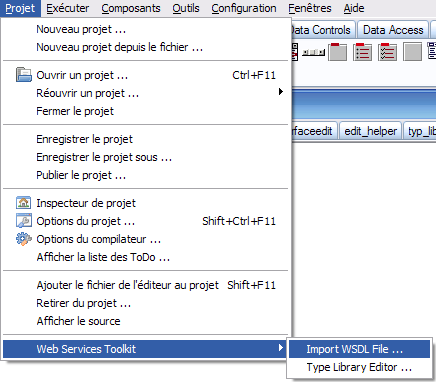
Cliquez sur le premier élément de menu (Importer Fichier WSDL ...), cela fera apparaître le dialogue ci-dessous. Nous spécifions le fichier WSDL et le dossier où stocker les fichiers générés et cliquez sur le bouton OK pour finir.
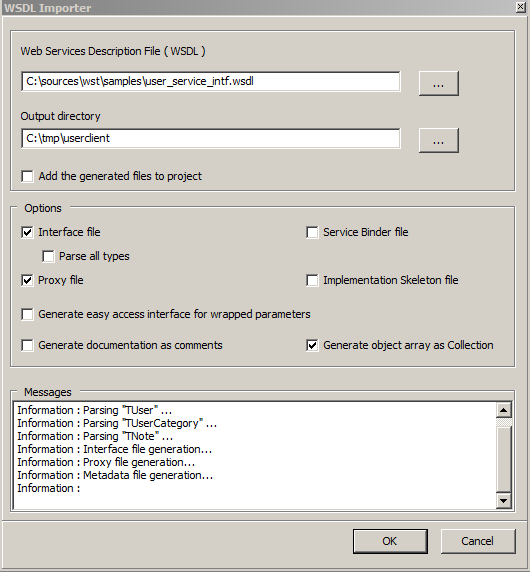
Cela va produire deux (2) fichiers source pascal :
- AWSECommerceService.pas, le fichier de définition du service ( équivalent Pascal du fichier WSDL )
- AWSECommerceService_proxy.pas, ce fichier contient un proxy qui implémente l'interface du service définie dans le premier fichier.
Import par ws_helper.
Le programme ws_helper est une version en ligne de commande de l'assistant d'import. Afin de présenter ses capacités, les arguments de ligne de commande qu'il supporte sont sont affichées ci-dessous.
ws_helper [-uMODE] [-p] [-b] [-i] [-oPATH] inputFilename
  -u MODE Generate the pascal translation of the WSDL input file
     MODE value may be U for used types or A for all types
  -p  Generate service proxy
  -b  Generate service binder
  -i  Generate service minimal implementation
  -o  PATH  Relative output directory
  -a  PATH  Absolute output directory
Pour traduire le fichier WDSL téléchargé depuis le site web "Amazon E-Commerce Service” exécutez la commande suivante à l'invite:
..\..\ws_helper\ws_helper.exe -uA -p -o. AWSECommerceService.wsdl
ws_helper, Web Service Toolkit 0.4 Copyright (c) 2006, 2007 by Inoussa OUEDRAOGOParsing the file : AWSECommerceService.wsdl
(...)
Interface file generation...
Proxy file generation...
Metadata file generation...
File "AWSECommerceService.wsdl" parsed succesfully.ci-dessous est affiché un extrait des deux fichiers :
unit AWSECommerceService;
{$IFDEF FPC} {$mode objfpc}{$H+} {$ENDIF}
interface

uses SysUtils, Classes, TypInfo, base_service_intf, service_intf;

const
  sNAME_SPACE = 'http://webservices.amazon.com/AWSECommerceService/2007-04-04';
  sUNIT_NAME = 'AWSECommerceService';

type

  HelpRequest = class;
  Help_RequestArray = class;

(...)

  AWSECommerceServicePortType = interface(IInvokable)
    ['{305A7E48-DD92-4C20-B699-4F2B47C93342}']
    function Help(
      Const HelpParam : Help_Type
    ):HelpResponse_Type;
    function ItemSearch(
      Const ItemSearchParam : ItemSearch_Type
    ):ItemSearchResponse_Type;
    function ItemLookup(
      Const ItemLookupParam : ItemLookup_Type
    ):ItemLookupResponse_Type;
    (...)
  end;

procedure Register_AWSECommerceService_ServiceMetadata();Unit AWSECommerceService_proxy;
{$IFDEF FPC} {$mode objfpc}{$H+} {$ENDIF}
Interface
Uses SysUtils, Classes, TypInfo, base_service_intf, service_intf, AWSECommerceService;
Type
TAWSECommerceServicePortType_Proxy=class(TBaseProxy,AWSECommerceServicePortType)
Protected
class function GetServiceType() : PTypeInfo;override;
function Help(
Const HelpParam : Help_Type
):HelpResponse_Type;
function ItemSearch(
Const ItemSearchParam : ItemSearch_Type
):ItemSearchResponse_Type;
function ItemLookup(
Const ItemLookupParam : ItemLookup_Type
):ItemLookupResponse_Type;
(...)
End;
Function wst_CreateInstance_AWSECommerceServicePortType(
const AFormat : string = 'SOAP:';
const ATransport : string = 'HTTP:'
):AWSECommerceServicePortType;
Implementation
uses wst_resources_imp, metadata_repository;
Function wst_CreateInstance_AWSECommerceServicePortType(
const AFormat : string;
const ATransport : string
):AWSECommerceServicePortType;
Begin
Result := TAWSECommerceServicePortType_Proxy.Create(
'AWSECommerceServicePortType',
AFormat +
GetServiceDefaultFormatProperties(TypeInfo(AWSECommerceServicePortType)),
ATransport + 'address=' + GetServiceDefaultAddress(TypeInfo(AWSECommerceServicePortType))
);
End;
function TAWSECommerceServicePortType_Proxy.ItemSearch(
Const ItemSearchParam : ItemSearch_Type
):ItemSearchResponse_Type;
Var
locSerializer : IFormatterClient;
strPrmName : string;
Begin
locSerializer := GetSerializer();
Try
locSerializer.BeginCall('ItemSearch', GetTarget(),(Self as ICallContext));
locSerializer.Put('ItemSearch', TypeInfo(ItemSearch_Type), ItemSearchParam);
locSerializer.EndCall();
MakeCall();
locSerializer.BeginCallRead((Self as ICallContext));
TObject(Result) := Nil;
strPrmName := 'ItemSearchResponse';
locSerializer.Get(TypeInfo(ItemSearchResponse_Type), strPrmName, Result);
Finally
locSerializer.Clear();
End;
End;
(...)Noous avons maintenant la possibilité de construire un programme simple pour le service. La bibliothèque Synapse est requise pour compiler le programme pour qu'il soit utilisé pour les communications HTTP. Cette bibliothèque est téléchargeable gratuitement à cette adresse: 2. La bibliothèque Indy3 ou la bibliothèque ICS4 peuvent aussi être utilisées.
program amazon_sample;
{$mode objfpc}{$H+}
uses
  Classes, SysUtils, soap_formatter, synapse_http_protocol,
  metadata_repository, AWSECommerceService, AWSECommerceService_proxy;

const sACCES_ID = <Your AccesID here>;

function ReadEntry(const APromp : string):string ;
begin
  Result := '';
  Write(APromp);
  while True do begin
    ReadLn(Result);
    Result := Trim(Result);
    if ( Length(Result) > 0 ) then
      Break;
  end;
end;

var
  locService : AWSECommerceServicePortType;
  rqst : ItemSearch_Type;
  rsps : ItemSearchResponse_Type;
  rspsItem : Items_Type;
  i, j, k : Integer;
  itm : Item_Type;
begin
  SYNAPSE_RegisterHTTP_Transport();
  WriteLn('Web Services Toolkit Amazon sample');
  WriteLn('This sample demonstrates the "ItemSearch" method of the Amazon web service');
  WriteLn();
  rqst := ItemSearch_Type.Create();
  try
    locService := wst_CreateInstance_AWSECommerceServicePortType();
    rqst.AWSAccessKeyId := sACCES_ID;
    while True do begin
      rqst.Request.SetLength(1);
      rqst.Request[0].SearchIndex := ReadEntry('Enter the Search Index : ');
      rqst.Request[0].Availability := Available;
      rqst.Request[0].Count := 10;
      rqst.Request[0].MerchantId := 'Amazon';
      rqst.Request[0].ItemPage := 1;
      rqst.Request[0].Keywords := ReadEntry('Enter the Keywords : ');
      rsps := locService.ItemSearch(rqst);
      if ( rsps.OperationRequest.Errors.Length > 0 ) then begin
        WriteLn(Format('Errors ( %d ) : ',[rsps.OperationRequest.Errors.Length]));
        for i := 0 to Pred(rsps.OperationRequest.Errors.Length) do begin
          WriteLn(Format('  Error[%d] :',[i]));
          WriteLn('    ' + rsps.OperationRequest.Errors[i].Code);
          WriteLn('    ' + rsps.OperationRequest.Errors[i].Message);
        end;
      end else begin
        WriteLn(Format('Response ( %d ) : ',[rsps.Items.Length]));
        if Assigned(rsps) then begin
          for i := 0 to Pred(rsps.Items.Length) do begin
            rspsItem := rsps.Items[i];
            WriteLn('    TotalPages :' + IntToStr(rspsItem.TotalPages));
            WriteLn('    TotalResults :' + IntToStr(rspsItem.TotalResults));
            WriteLn('    Items :' + IntToStr(rspsItem._Item.Length));
            WriteLn('');
            for j := 0 to Pred(rspsItem._Item.Length) do begin
              itm := rspsItem._Item[j];;
              WriteLn('        ASIN :' + itm.ASIN);
              WriteLn('        DetailPageURL :' + itm.DetailPageURL);
              if Assigned(itm.ItemAttributes) then begin
                WriteLn('               Title :' + itm.ItemAttributes.Title);
                for k := 0 to Pred(itm.ItemAttributes.Author.Length) do begin
                  WriteLn('               Author[ ' + IntToStr(k) + ' ] ' + itm.ItemAttributes.Author.Item[k]);
                end;
                WriteLn('               Manufacturer :' + itm.ItemAttributes.Manufacturer);
                WriteLn('               ProductGroup :' + itm.ItemAttributes.ProductGroup);
              end;
              WriteLn('');
            end;
          end;
        end else begin
          WriteLn('Unexpected service response : Invalid response');
        end;
      end;
      WriteLn();
      WriteLn();
      if ( UpperCase(ReadEntry('Continue ( Y/N ) :'))[1] <> 'Y' ) then
        Break;
    end;
  finally
    FreeAndNil(rqst);
    FreeAndNil(rsps);
  end;
  ReadLn;
end.
Les unités base_service_intf, service_intf, soap_formatter, synapse_http_protocol, wst_resources_imp et metadata_repository sont fournies avec le toolkit; Ci-dessous le résultat d'une session d'exécution de recherche de “Freepascal” dans l'index de recherche “All” ( le service est sensible à la casse des caractères!) .
Web Services Toolkit Amazon sample
This sample demonstrates the "ItemSearch" method of the Amazon web serviceEnter the Search Index : All
Enter the Keywords : Freepascal
Response ( 1 ) :
TotalPages :1
TotalResults :9
Items :9ASIN :0470088702
DetailPageURL : http://www.amazon.com/gp/redirect.html%3FASIN=0470088702%26tag=ws%26lcode=sp1%26cID=2025%26ccmID=165953%26location=/o/ASIN/0470088702%253FSubscriptionId=0W3H25JMMGBNBXSTQN82
Title :Beginning Programming For Dummies (Beginning Programming for Dummies)
Author[ 0 ] Wallace Wang
Manufacturer :For Dummies
ProductGroup :BookASIN :0471375233
DetailPageURL : http://www.amazon.com/gp/redirect.html%3FASIN=0471375233%26tag=ws%26lcode=sp1%26cID=2025%26ccmID=165953%26location=/o/ASIN/0471375233%253FSubscriptionId=0W3H25JMMGBNBXSTQN82
Title :Assembly Language Step-by-step: Programming with DOS and Linux (with CD-ROM)
Author[ 0 ] Jeff Duntemann
Manufacturer :Wiley
ProductGroup :Book(...)Cela trouve une (1) page contenant neuf (9) items! La fonction wst_CreateInstance_AWSECommerceServicePortType(), située dans le fichier AWSECommerceService.pas crée une instance de proxy basé sur les informations du service contenu dans le fichier WSDL.
Function wst_CreateInstance_AWSECommerceServicePortType(
  const AFormat    : string;
  const ATransport : string
):AWSECommerceServicePortType;
Begin
  Result := TAWSECommerceServicePortType_Proxy.Create(
              'AWSECommerceServicePortType',
              Aformat + GetServiceDefaultFormatProperties(TypeInfo(AWSECommerceServicePortType)),
              ATransport + 'address=' + GetServiceDefaultAddress(TypeInfo(AWSECommerceServicePortType))
            );
End;
Le code source complet de l'exemple d'Amazon est situé dans le dossier \samples\amazon pour fpc; L'exemple Delphi est situé dans le dossier \samples\delphi\amazon.
Paramètres de Connection
Le format général est:
protocol:paramName=paramValue(;paramName=paramValue)*Paramètres de Proxy HTTP Proxy
Pour HTTP, les paramètres supportés sont les suivants:
- Address ( required for a service supporting a unique address )
- ProxyServer
- ProxyPort
- ProxyUsername
- ProxyPassword
Les connexions HTTP via un proxy sont supportées. Ci-dessous un exemple de chaîne d'adresse.
  const
    sADDRESS = 'http:address=http://webservices.amazon.com/AWSECommerceService/2007-04-04'+
                 ';ProxyServer=197.150.10.10;ProxyPort=9881'+
                 ';ProxyUsername=inoussa;ProxyPassword=wst';
Le toolkit a deux implémentations TCP basées sur Synapse ( synapse_tcp_protocol.pas ) et ICS ( ics_tcp_protocol.pas ).
Paramètres de connexion TCP
Les paramètres TCP supportés sont:
- address ( requis pour un service supportant une adresse unique )
- Port
- target( le service cible )
Ci-dessous un exemple de chaîne d'adresse.
  Const
    sADDRESS = 'TCP:Address=10.0.0.3;Port=1234;target=UserService';
The toolkit has two TCP implementations based on Synapse ( synapse_tcp_protocol.pas ) and ICS ( ics_tcp_protocol.pas ).
Paramètres de connexion LIBRARY ( LIB )
L'idée derrière ce protocole est d'être capable d'héberger des services dans des bibliothèques dynamiques ( DLL/DSO ). Cela peut -être vu comme un framework à plugins où les where plugins ( services ) sont fournis par des bibliothèques dynamiques. Les paramètres de LIB supportés sont:
- FileName ( le nom du fichier DLL/SO )
- target( le service cible )
Ci-dessous un exemple de chaîne d'adresse.
  Const
    sADDRESS = 'LIB:FileName=..\library_server\lib_server.dll;target=UserService';
Le toolkit a une implémentation LIB ( library_protocol.pas ).
Le dossier d'exemples contient 4 projets user_client_console, tcp_server, http_server et library_server qui font la démonstration des protocoles TCP, HTTP et LIBRARY.
Service Multi-Adresses ( une adresse par opération )
Certains services ( comme les services SOAP eBay ) utilisent une adresse par opération. Le toolkit utilise des meta data étendues ( voir les meta data de services au chapitre précédent ) pour choisir les adresses des opération. L'exemple SOAP “ebay” situé dans le dossier tests\ebay fait la démonstration de la configuration de l'adresse par opération.
Server Side ( service creation )
Overview
Web Service Toolkit contains a server side framework and a WSDL based type library editor for service creation. Key features are:
- Service definition ( interface ) is separated from implementation,
- Interface and implementations are not bound to message protocol,
- WSDL generation
- Support for SOAP 1.1 serialization
- Support for XMLRPC serialization
- Support for custom binary serialization
- The framework is not bound to a transport protocol
- Easy to add support for application servers.
Example
In order to create a service, we have to :
- define its interface,
- provide an implementation and register that one for the service,
- provide a binder that will route calls targeting the service to the implementation and register that one,
- host the service into an application server( TCP server, HTTP Server, LIBRARY server, ... ).
Defining the service Interface
Starting from the 0.5 version, the WST provides a WSDL based Type library Editor to define types and services used by an implementation. The figure (3) below presents the general interface of this tool. The Type library Editor is provided as
- a Lazarus wizard as a menu item “Project/Web Services Toolkit/Type Library Editor..”
- a standalone program typ_lib_edtr.exe.
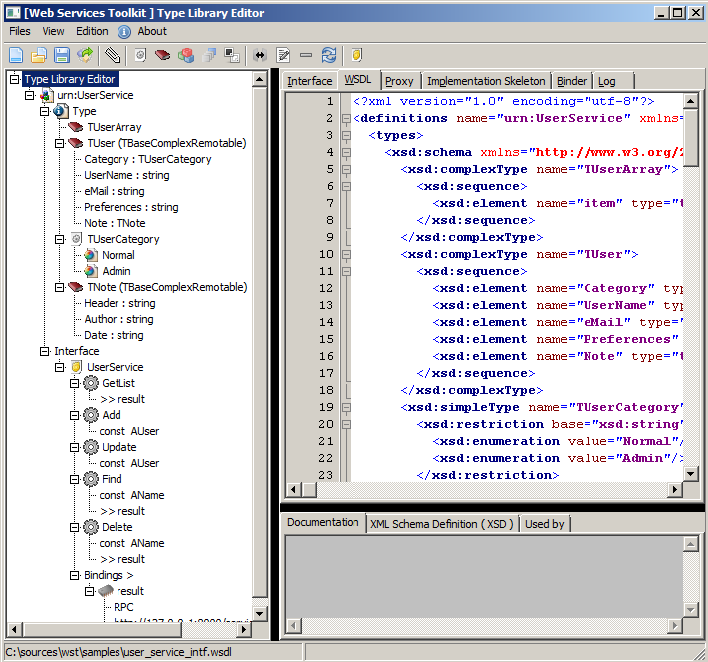
Type Library Editor features:
- Graphical user interface
- WSDL source view
- Pascal source view of the library
- Pascal Proxy source view
- Pascal implementation skeleton source view
- Pascal Proxy binder view
- enumeration creation interface
- class creation interface
- array creation interface
- type alias creation interface
- service interface creation interface.
Below are showed some sample images. We will use the user_service_intf.wsdl file located in the \samples directory for our sample.
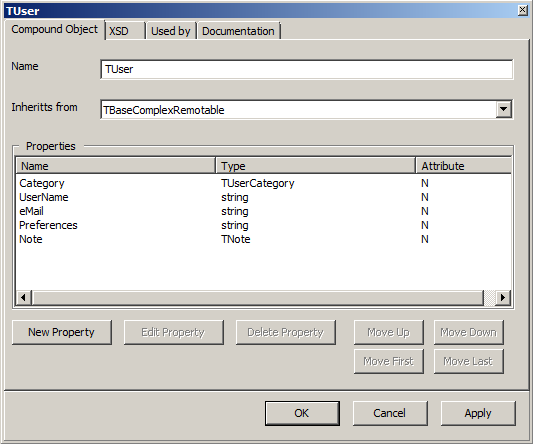
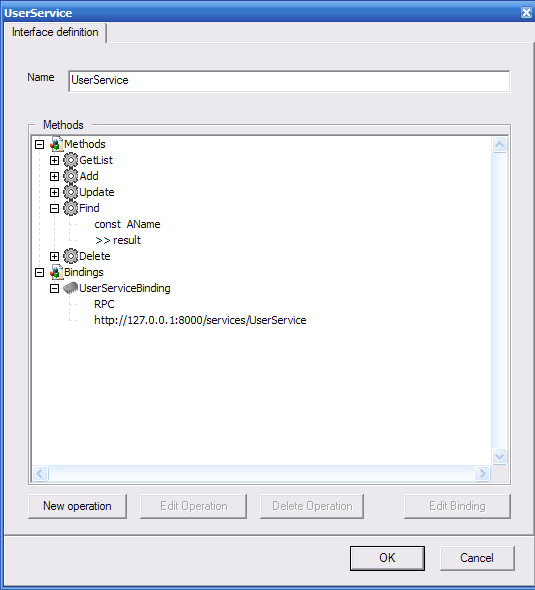
Export the pascal files.
The Type Library Editor has option to generate the pascal version of the WSDL file. To do so, click on the “Files\Save generated files ...” ( it can also be done through the contextual menu ); It will bring up the dialog box showed in the following image. 
Click OK the button to complete. The program ws_helper has the same capabilities and the files can be generated with the following command :
ws_helper\ws_helper.exe -i -b -o. user_service_intf.pas
ws_helper, Web Service Toolkit 0.5 Copyright (c) 2006, 2007 by Inoussa OUEDRAOGO
Parsing the file : user_service_intf.wsdl
Information : Parsing "tns:TUserArray" ...
Information : Parsing "tns:TUser" ...
Information : Parsing "tns:TUser" ...
Information : Parsing "xsd:string" ...
Information : Parsing "tns:TUser" ...
Information : Parsing "xsd:string" ...
Information : Parsing "xsd:boolean" ...
Information : Parsing "TUserArray" ...
Information : Parsing "TUser" ...
Information : Parsing "TUserCategory" ...
Information : Parsing "TNote" ...
Interface file generation...
Proxy file generation...
Metadata file generation...
File "user_service_intf.wsdl" parsed succesfully.
The complete projects of the example is located in the folder “samples”. Below is printed a extract of the generated interface file.
unit user_service_intf;
{$IFDEF FPC} {$mode objfpc}{$H+} {$ENDIF}
interface

uses SysUtils, Classes, TypInfo, base_service_intf, service_intf;

const
  sNAME_SPACE = 'urn:UserService';
  sUNIT_NAME = 'user_service_intf';

type

  TUser = class;
  TUserArray = class;

  TUserCategory = (
    Normal
    ,Admin
  );

  TUser = class(TBaseComplexRemotable)
  published
    property Category : TUserCategory read FCategory write FCategory;
    property UserName : string read FUserName write FUserName;
    property eMail : string read FeMail write FeMail;
    property Preferences : string read FPreferences write FPreferences;
    property Note : TNote read FNote write FNote;
  end;

  TUserArray = class(TBaseObjectArrayRemotable)
  private
    function GetItem(AIndex: Integer): TUser;
  public
    class function GetItemClass():TBaseRemotableClass;override;
    property Item[AIndex:Integer] : TUser Read GetItem;Default;
  end;

  UserService = interface(IInvokable)
    ['{CA6F6192-C3DE-4D9C-B3DF-E616376A0DC9}']
    function GetList():TUserArray;
    procedure Add(
      Const AUser : TUser
    );
    procedure Update(
      Const AUser : TUser
    );
    function Find(
      Const AName : string
    ):TUser;
    function Delete(
      Const AName : string
    ):boolean;
  end;
(...)
Providing an implementation for the service
The user_service_intf_imp.pas unit generated above contains a skeleton implementation class for the interface. It defines a procedure named RegisterUserServiceImplementationFactory. The procedure registers the class as the service implementation provider in the implementation registry.
Unit user_service_intf_imp;
{$IFDEF FPC} {$mode objfpc}{$H+} {$ENDIF}
Interface
Uses SysUtils, Classes,
     base_service_intf, server_service_intf, server_service_imputils,
     user_service_intf, cursor_intf;

Type
  { TUserService_ServiceImp }

  TUserService_ServiceImp=class(TBaseServiceImplementation,UserService)
  Protected
    function GetList():TUserArray;
    procedure Add(
      Const AUser : TUser
    );
    procedure Update(
      Const AUser : TUser
    );
    function Find(
      Const AName : string
    ):TUser;
    function Delete(
      Const AName : string
    ):boolean;
  End;

  procedure RegisterUserServiceImplementationFactory();

Implementation
(...)

procedure TUserService_ServiceImp.Add(Const AUser : TUser);
var
  locObj : TUser;
Begin
  locObj := Find(AUser.UserName);
  if ( locObj <> nil ) then
    raise Exception.CreateFmt('Duplicated user : "%s"',[AUser.UserName]);
  locObj := TUser.Create();
  locObj.Assign(AUser);
  FUserList.Add(locObj);
End;

procedure RegisterUserServiceImplementationFactory();
Begin
  GetServiceImplementationRegistry().Register(
    'UserService',
TImplementationFactory.Create(TUserService_ServiceImp) as IServiceImplementationFactory);
End;

(...)
“ws_helper” has options to generate proxy file, basic implementation skeleton file and a binder file ( see the following listing).
ws_helper, Web Service Toolkit 0.4 Copyright (c) 2006, 2007 by Inoussa OUEDRAOGO
ws_helper [-uMODE] [-p] [-b] [-i] [-oPATH] inputFilename
  -u MODE Generate the pascal translation of the WSDL input file
       MODE value may be U for used types or A for all types
  -p  Generate service proxy
  -b  Generate service binder
  -i  Generate service minimal implementation
  -o  PATH  Relative output directory
  -a  PATH  Absolute output directory
The starting implementation file could also be create using ws_helper with the -i and -b options as above;
ws_helper\ws_helper.exe -i -b -o. user_service_intf.wsdl
ws_helper, Web Service Toolkit 0.4 Copyright (c) 2006, 2007 by Inoussa OUEDRAOGO
Parsing the file : user_service_intf.wsdl
Proxy file generation...
Binder file generation...
Implementation file generation...
Metadata file generation...
File "user_service_intf.wsdl" parsed succesfully..
Providing a binder for the service.
The binder's role is to:
- unpack the incoming message,
- set up the call stack,
- make the call against the registered implementation,
- serialize the execution stack to create the return message.
The user_service_intf_binder.pas unit generated above, contains :
- TUserService_ServiceBinder : the actual binder class,
- TUserService_ServiceBinderFactory a factory class for the binder and
- Server_service_RegisterUserServiceService : the binder factory registration procedure.
The following code extract shows the unit interface part and a method handler of the binder.
unit user_service_intf_binder;
{$IFDEF FPC} {$mode objfpc}{$H+} {$ENDIF}
interface
uses SysUtils, Classes, base_service_intf, server_service_intf, user_service_intf;

type
  TUserService_ServiceBinder=class(TBaseServiceBinder)
  Protected
    procedure GetListHandler(AFormatter:IFormatterResponse);
    procedure AddHandler(AFormatter:IFormatterResponse);
    procedure UpdateHandler(AFormatter:IFormatterResponse);
    procedure FindHandler(AFormatter:IFormatterResponse);
    procedure DeleteHandler(AFormatter:IFormatterResponse);
  Public
    constructor Create();
  End;

  TUserService_ServiceBinderFactory = class(TInterfacedObject,IItemFactory)
  protected
    function CreateInstance():IInterface;
  End;

  procedure Server_service_RegisterUserServiceService();

(...)

procedure TUserService_ServiceBinder.AddHandler(AFormatter:IFormatterResponse);
Var
  cllCntrl : ICallControl;
  tmpObj : UserService;
  callCtx : ICallContext;
  strPrmName : string;
  procName,trgName : string;
  AUser : TUser;
Begin
  callCtx := GetCallContext();
  TObject(AUser) := Nil;

  strPrmName := 'AUser';  AFormatter.Get(TypeInfo(TUser),strPrmName,AUser);
  If Assigned(Pointer(AUser)) Then
    callCtx.AddObjectToFree(TObject(AUser));

  tmpObj := Self.GetFactory().CreateInstance() as UserService;
  if Supports(tmpObj,ICallControl,cllCntrl) then
    cllCntrl.SetCallContext(GetCallContext());

  tmpObj.Add(AUser);

  procName := AFormatter.GetCallProcedureName();
  trgName := AFormatter.GetCallTarget();
  AFormatter.Clear();
  AFormatter.BeginCallResponse(procName,trgName);
  AFormatter.EndCallResponse();

  callCtx := Nil;
End;
Host the service into an application server.
The application server's role is to route incoming service requests to the Web Service Toolkit runtime. For the runtime to process service requests :
- The services and their implementations have to be registered ,
- The message protocol (SOAP, binary,...) have to be registered.
The runtime interface is defined in the server_service_intf unit. This unit contains :
- GetServerServiceRegistry, which returns the service registry,
- GetServiceImplementationRegistry which returns the service implementation registry,
- GetFormatterRegistry which returns the message format registry and
- HandleServiceRequest which is the unique entry point for request processing.
Starting from the version 0.5, the toolkit provides a simplified model to develop applications server . This is achieved using the listener classes. A listener implements a transport between the server and its clients. The toolkit provides three (3) listeners implementations:
- TwstIndyHttpListener ( indy_http_server.pas ),
- TwstIndyTcpListener ( indy_tcp_server.pas ) and
- TwstSynapseTcpListener ( synapse_tcp_server.pas ).
All listeners derive from TwstListener defined in the server_listener.pas file.
Below is printed a Indy based HTTP server sample. The code is divided into three (3) parts :
- messaging format registration :
  Server_service_RegisterSoapFormat();
  Server_service_RegisterXmlRpcFormat();
Server_service_RegisterBinaryFormat() ;- service implementation and binder registration :
  RegisterUserServiceImplementationFactory();
Server_service_RegisterUserServiceService();- the listner creation and starting : the listener is created and started by the lines
  AppObject  := TwstIndyHttpListener.Create();
  AppObject.Start();
Complete listing :
program http_server;
{$mode objfpc}{$H+}
uses
  {$IFDEF UNIX}{$IFDEF UseCThreads}
  cthreads,
  {$ENDIF}{$ENDIF}
  Classes, SysUtils,
  indy_http_server, metadata_service, logger_extension, server_listener,
  server_service_soap, server_binary_formatter, server_service_xmlrpc, config_objects,
  user_service_intf, user_service_intf_binder, user_service_intf_imp;
var
  AppObject : TwstListener;
begin
  Server_service_RegisterBinaryFormat();
  Server_service_RegisterSoapFormat();
  Server_service_RegisterXmlRpcFormat();

  RegisterUserServiceImplementationFactory();
  Server_service_RegisterUserServiceService();
  AppObject := TwstIndyHttpListener.Create();
  try
    WriteLn('"Web Service Toolkit" HTTP Server sample listening at:');
    WriteLn('');
    WriteLn('http://127.0.0.1:8000/');
    WriteLn('');
    WriteLn('Press enter to quit.');
    AppObject.Start();
    ReadLn();
  finally
    FreeAndNil(AppObject);
  end;
end.
Server_service_RegisterUserServiceService located in the user_service_intf_binder unit ( generated by ws_helper ) registers the UserService service by calling in turn GetServerServiceRegistry:
procedure Server_service_RegisterUserServiceService();
Begin
  GetServerServiceRegistry().Register(
    'UserService',TUserService_ServiceBinderFactory.Create() as IitemFactory
  );
End;
Server_service_RegisterSoapFormat located in the server_service_soap unit ( provided by the toolkit ) registers the SOAP implementation by calling in turn GetFormatterRegistry:
  procedure Server_service_RegisterSoapFormat();
  begin
    GetFormatterRegistry().Register(
      sPROTOCOL_NAME,
      sSOAP_CONTENT_TYPE,
      TSimpleItemFactory.Create(TSOAPFormatter) as IitemFactory
    );
    RegisterStdTypes();
  end;
Server_service_RegisterBinaryFormat located in the server_binary_formatter unit ( provided by the toolkit ) registers the Binary message implementation by calling in turn GetFormatterRegistry:
  procedure Server_service_RegisterBinaryFormat();
  begin
    GetFormatterRegistry().Register(
      sPROTOCOL_NAME,
      sBINARY_CONTENT_TYPE,
      TBinaryFormatterFactory.Create() as IitemFactory
    );
  end;
Server_service_RegisterXmlRpcFormat located in the server_service_xmlrpc unit ( provided by the toolkit ) registers the XMLRPC message implementation by calling in turn GetFormatterRegistry:
  procedure Server_service_RegisterXmlRpcFormat();
  begin
    GetFormatterRegistry().Register(
      sPROTOCOL_NAME,
      sXMLRPC_CONTENT_TYPE,
      TSimpleItemFactory.Create(TXmlRpcFormatter) as IItemFactory
    );
  end;
In order to give it a try one have to :
- compile the server ( \samples\tcp_server\tcp_server.lpi it is a console program),
- compile the client application ( \samples\user_client_console\user_client_console.lpi ),
- execute the server and start listening,
- execute the client.
WSDL generation
Services in the toolkit are organized into meta data repositories. Conceptually a repository corresponds :
- at compile time to the pascal unit containing the service definition
- at runtime to a name space.
The repository is the toolkit WSDL generation unit.
The Metadata Service
The toolkit is provided with an easy to use metadata service implementation which in turn uses the raw interface defined in the metadata_repository unit (see above). A Lazarus GUI client application is located in the tests\metadata_browser folder.
WSDL generation API
The metadata_wsdl pascal unit contains the GenerateWSDL function for WSDL generation from a repository (see the signature below).
  PServiceRepository = ^TServiceRepository;
  TServiceRepository = record
    NameSpace        : ShortString;
    Name             : ShortString;
    RootAddress      : ShortString;
    ServicesCount    : Byte;
    Services         : PService;
  end;

  procedure GenerateWSDL(AMdtdRep : PServiceRepository; ADoc : TDOMDocument);
WSDL Customization
The WSDL generation is based on the IWsdlTypeHandler and the IWsdlTypeHandlerRegistry interfaces located in the metadata_wsdl unit. In order to customize the generated WSDL, one has to provide a class implementing the IWsdlTypeHandler interface. Then that class has to be registered in the registry. The metadata_wsdl unit contains implementations for pascal enumerations, TBaseComplexRemotable descendants, and TBaseArrayRemotable descendants.
Sample
A functional sample project is located under \samples\http_server . It is an Indy base http server.
Services Extensions
Services extensions provide a mean to hook into all the services request processing stages. Services extensions may be used, for example, to implement authentication, request logging, data compression, etc. The IServiceExtension bellow is the interface used by the toolkit runtime to call services extensions.
  TMessageStage = (
    msAfterDeserialize, msAfterSerialize, msBeforeDeserialize, msBeforeSerialize
  );

  IServiceExtension = interface
    ['{E192E6B3-7932-4D44-A8AC-135D7A0B8C93}']
    procedure ProcessMessage(
      const AMessageStage     : TMessageStage;
               ACallContext   : ICallContext;
               AMsgData       : IInterface
    );
  end;
The AMsgData parameter actual type depends on the message processing state and corresponds to :
- IRequestBuffer on "msBeforeDeserialize" and "msAfterSerialize"
- IFormatterResponse on "msAfterDeserialize" and "msBeforeSerialize"
These types are located in the server_service_intf unit. Extensions have to be registered in the extensions registry ( located in the server_service_intf unit ) printed bellow
  IServiceExtensionRegistry = Interface
    ['{68DC78F1-E6CF-4D6B-8473-75288794769C}']
    function Find(const AName : string):IServiceExtension;
    procedure Register(
      const AName    : string;
            AFactory : IItemFactory
    );
  end;
In order for an service implementation to use a service extension, it has to register himself to that extension. To that end, the IServiceImplementationFactory interface provides the RegisterExtension method. A complete sample is included in the \samples\http_server sample ( implemented in \samples\logger_extension.pas ).
Services meta data
Services in the toolkit are organized into ***meta data repositories( see the “services's meta data” below )***. Conceptually a repository corresponds :
- at compile time to the pascal unit containing the service definition
- at runtime to a name space.
The ws_helper tool, when parsing the interface definition file, records the meta data of the services contained in the file to a Lazarus resource file. The resource file is then embedded into the generated binder's unit file( see the unit “initialization” part ). At runtime the service's recorded meta data are accessible through the interface IModuleMetadataMngr defined in the metadata_repository unit ( see below ). The GetModuleMetadataMngr function defined in the same unit returns an instance of an object supporting that interface.
  IModuleMetadataMngr = interface
    ['{B10ACF6A-A599-45A3-B083-BEEFB810C889}']
    function IndexOfName(const ARepName : shortstring):Integer;
    function GetCount():Integer;
    function GetRepositoryName(const AIndex : Integer):shortstring;
    procedure SetRepositoryNameSpace(const ARepName,ANameSpace : shortstring);
    function LoadRepositoryName(
      const ARepName,ARootAddress  : shortstring;
      out   ARepository  : PServiceRepository
    ):Integer;
    procedure ClearRepository(var ARepository : PServiceRepository);
    procedure SetServiceCustomData(
      const ARepName       : shortstring;
      const AServiceName   : shortstring;
      const ADataName,
            AData          : string
    );
    procedure SetOperationCustomData(
      const ARepName       : shortstring;
      const AServiceName   : shortstring;
      const AOperationName : shortstring;
      const ADataName,
            AData          : string
    );
    function GetServiceMetadata(const ARepName,AServiceName : shortstring) : PService;
    procedure ClearServiceMetadata(var AService : PService);
  end;
Extended Meta data
The meta data interface provides a way to add custom data to recorded ones. Services's metadata can be set through SetServiceCustomData, operation's metadata be set through the SetOperationCustomData method. A repository's extended meta data has to be registered after the service meta data recorded in the resource file have been registered. So for client application the generated proxy unit contains a conditional code fragment to call a registration procedure like showed below for the eBay sample located in the tests\ebay folder. The procedure name is obtained from the interface unit name ( the repository's name ) : Register_%UNIT_NAME%_ServiceMetadata .
  initialization
    {$i ebay.lrs}

    {$IF DECLARED(Register_ebay_ServiceMetadata)}
    Register_ebay_ServiceMetadata();
    {$ENDIF}
  End.
Headers support
The THeaderBlock class
  THeaderBlock = class(TBaseComplexRemotable)
  public
    property Direction : THeaderDirection read FDirection write FDirection;
    property Understood : Boolean read FUnderstood write FUnderstood;
  published
    property mustUnderstand : Integer read FmustUnderstand write SetmustUnderstand
      stored HasmustUnderstand;
  end;
The THeaderBlock showed above ( the private part has been omitted for brevity), located in the base_service_intf unit, is the root class all header classes are derived from.. The Direction property indicate whether it is an incoming header or an outgoing one. The mustUnderstand property define whether the header is a mandatory one.
Defining header class
Soap headers are derived from the THeaderBlock base class located in the base_service_intf unit. They have to be registered in the type registry. Below is reproduced an header example extracted from the “calculator” sample project.
  TCalcHeader = class(THeaderBlock)
  published
    property Login : string read FLogin write FLogin;
    property Password : string read FPassword write FPassword;
    property WantedPrecision : Integer read FWantedPrecision write FWantedPrecision;
  end;
</synraxhighlight>

=== The ICallContext interface ===
<syntaxhighlight lang=pascal>
  ICallContext = Interface
    ['{855EB8E2-0700-45B1-B852-2101023200E0}']
    procedure AddObjectToFree(const AObject : TObject);
    procedure Clear();
    function AddHeader(
      const AHeader        : THeaderBlock;
      const AKeepOwnership : Boolean
    ):Integer;
    function GetHeaderCount(const ADirections : THeaderDirections):Integer;
    function GetHeader(const AIndex : Integer) : THeaderBlock;
    procedure ClearHeaders(const ADirection : THeaderDirection);
  End;
The ICallContext interface defined in the base_service_intf unit represents the service call context. The AddHeader method allows headers sending while the GetHeader method retrieves header in the call context.
Client side headers
An ICallContext reference may be obtained from the current service proxy instance simply by querying it for that interface as showed in the code fragment below extracted from the “calculator” client example project.
  var
    ch : TCalcHeader;
    hdrs : ICallContext;
  begin
    FObj := TCalculator_Proxy.Create('Calculator', edtFormat.Text, edtAddress.Text);

    ch := TCalcHeader.Create();
    ch.mustUnderstand := 1;
    ch.Login := 'azerty';
    ch.Password := 'qwerty';
    ch.WantedPrecision := 1210;
    hdrs := FObj as ICallContext;
    hdrs.AddHeader(ch,true);
A header may be made mandatory by setting its mustUnderstand property to 1 as in the code above.
Server side headers
The ICallControl interface
  ICallControl = interface
    ['{7B4B7192-EE96-4B52-92C7-AE855FBC31E7}']
    procedure SetCallContext(ACallContext : ICallContext);
    function GetCallContext():ICallContext;
  end;
The ICallControl interface, located in the server_service_intf unit, is used by the toolkit runtime to share the executing call environment with service implementation classes. When the runtime is about to issue a call against a implementation class instance, it queries that instance for ICallControl interface support; If the implementation has ICallControl interface support then the obtained reference is used to set the call context through the SetCallContext method. The implementation instance can then access the call context by calling the GetCallContex method. The toolkit provides the TBaseServiceImplementation class which has support for the ICallControl interface and can be used as a base implementation class. It is the base class used by the ws_helper generated skeleton implementation class when invoked with the -i command line option. The method printed bellow, extracted from the calculator sample service demonstrates the access to headers for read and write.
  function TCalculator_ServiceImp.AddInt(
    Const A : Integer;
    Const B : Integer
  ):TBinaryArgsResult;
  var
    hdr : TCalcResultHeader;
    h : TCalcHeader;
    cc : ICallContext;
  Begin
    hdr := TCalcResultHeader.Create();
    cc := GetCallContext();
    if Assigned(cc) and ( cc.GetHeaderCount([hdIn]) > 0 ) and ( cc.GetHeader(0).InheritsFrom(TCalcHeader) ) then begin
      h := cc.GetHeader(0) as TCalcHeader;
      h.Understood := True;
      hdr.Assign(h);
    end;
    hdr.TimeStamp := DateTimeToStr(Now());
    hdr.SessionID := 'testSession';
    cc.AddHeader(hdr,True);
    hdr := nil;
    Result := TBinaryArgsResult.Create();
    Try
      Result.Arg_OP := '+';
      Result.Arg_OpEnum := coAdd;
      Result.Arg_A := A;
      Result.Arg_B := B;
      Result.Arg_R := A + B;
      Result.Comment := 'Doing an + operation';
    Except
      FreeAndNil(Result);
      Raise;
    End;
  End;
SOAP Specific
Binding style
The binding style is used to indicate whether the service is RPC oriented or Document oriented.
Client side
The binding style may be specified in the SOAP protocol string on the creation of a service proxy. The default value for the binding style is RPC. Below is printed a sample code that demonstrates the use of Document style.
  locService := TSampleService_Proxy.Create(
                  'SampleService',
                  'SOAP:Style=Document;EncodingStyle=Litteral',
                  'http:Address=http://127.0.0.1/services/SampleService'
                );
Server side
Currently services created with the toolkit use the RPC binding style.
Encoding style
The encoding style indicates the rules used to encode types in XML. Supported values are Encoded and Litteral.
Client side
The encoding style may be specified in the SOAP protocol string on the creation of a service proxy. The default value for the encoding style is Encoded. The above sample demonstrates the use of Litteral style.
Server side
Currently services created with the toolkit use the Encoded encoding style.
Provided examples
The samples are located under the “tests” folder.
Client side examples ( tested on Windows XP, Ubuntu and MacOS on PowerPC)
- UserService, samples\http_server, samples\tcp_server, samples\user_client_console, sample\library_server : the client console uses the three client and server protocols (HTTP, TCP, LIBRARY)
- Google sample : It demonstrates use of class and array data types .
- Metadata Browser : This sample demonstrates use of class and array data types and mainly the toolkit metadata service.
- eBay sample, this sample uses OpenSLL which can be found at http://www.openssl.org and SYNAPSE ( http://www.ararat.cz/synapse/ ).
- \samples\delphi\ : This folder contains Delphi ( compile with Delphi 7) client and server samples. Used protocol : the TCP, HTTP, LIBRARY; Used format : SOAP, XMLRPC and BINARY.
Server side examples
- samples\tcp_server : This is a sample TCP server based on the Synapse components. It uses the UserService.
- samples\http_server : This is a sample HTTP server based on the Indy10 components. It uses the UserService and the toolkit metadata service. It demonstrates the WSDL generation.
- samples\apache_module : Apache module sample, this sample demonstrates the hosting of the toolkit into the Apache HTTP web server. It is based on Sekelsenmat's Apache headers translation. It uses the UserService service and the toolkit metadata service. It demonstrates the WSDL generation.
Status
The toolkit is usable for simple types and for class types. The serialization is designed to allow customization of basic types and class types by implementing classes derived from “TBaseRemotable”. This classes have to be registered in the type registry.
Serialization
The serialization is based on the IFormatterBase interface located in the base_service_intf unit.
The toolkit has three serializers implementations : the SOAP serializer, the XMLRPC serializer and a binary serializer. This serializers has been tested on fpc 2.x and Delphi 7.
SOAP serializer
The SOAP serializer implements SOAP 1.1. It has support for the following pascal types:
- Available integers :
- Byte mapped to unsignedByte
- ShortInt mapped to byte
- SmallInt mapped to short
- Word mapped to unsignedShort
- LongInt mapped to int
- LongWord mapped to unsignedInt
- Int64 mapped to long
- QWord mapped to int
- String mapped to string
- Boolean mapped to boolean
- Enumerations mapped to their string representation
- Float types :
- Single mapped to float
- Double mapped to double
- Extended mapped to double
- Currency mapped to float
- Object (class instances, not TP ones ) : The toolkit has support for instances of classes derived from TBaseRemotable. TBaseRemotable is the base class used by the formatter interface to allow customization of the serialization. The toolkit provides the TBaseComplexRemotable class which implements serialization for its ( or its descendants ) published properties.
Binary serializer
The Binary serializer is more efficient in time and space compared to the SOAP serializer . It uses big endian to stream data. It has support for the following pascal types:
- Available integers :
- Byte
- ShortInt
- SmallInt
- Word
- LongInt
- LongWord
- Int64
- QWord
- String
- Boolean
- Enumerations
- Float types :
- Single
- Double
- Extended
- Currency
- Object (class instances, not TP ones ) :The toolkit has support for instances of classes derived from TBaseRemotable. TBaseRemotable is the base class used by the formatter interface to allow customization of the serialization. The toolkit provides the TBaseComplexRemotable class which implements serialization for its ( or its descendants ) published properties.
Class type serialization
The toolkit has support for instances of classes derived from TBaseRemotable. TBaseRemotable is the abstract base class used by the formatter interface to allow customization of the serialization. The toolkit provides the TBaseComplexRemotable class which implements serialization for its descendants classes published properties. It also provides TBaseObjectArrayRemotable class for serialization of array of TBaseRemotable descendant classes.
The root “TBaseRemotable” class
  TBaseRemotable = class(TPersistent)
  Public
    constructor Create();virtual;
    class procedure Save(
            AObject   : TBaseRemotable;
            AStore    : IFormatterBase;
      Const AName     : String;
      Const ATypeInfo : PTypeInfo
    );virtual;abstract;
    class procedure Load(
      Var   AObject   : TObject;
            AStore    : IFormatterBase;
      var   AName     : String;
      const ATypeInfo : PTypeInfo
    );virtual;abstract;
  End;
TBaseRemotable is the abstract base class used by the formatter interface to allow customization of the serialization. This class defines a virtual constructor and mainly two(2) virtual abstract class methods :
- Save : this method is called when the toolkit needs to serialize the AObject parameter.
- Load: this method is called when the toolkit needs to un-serialize to the AObject parameter.
The “TBaseComplexRemotable” serialization
  TBaseComplexRemotable = class(TAbstractComplexRemotable)
  public
    class procedure Save(
            AObject   : TBaseRemotable;
            AStore    : IFormatterBase;
      const AName     : string;
      const ATypeInfo : PTypeInfo
    );override;
    class procedure Load(
      var   AObject   : TObject;
            AStore    : IFormatterBase;
      var   AName     : string;
      const ATypeInfo : PTypeInfo
    );override;
    class procedure RegisterAttributeProperty(const AProperty : shortstring);virtual;
    class procedure RegisterAttributeProperties(const APropertList : array of shortstring);virtual;
    class function IsAttributeProperty(const AProperty : shortstring):Boolean;
    procedure Assign(Source: TPersistent); override;
  end;
TBaseComplexRemotable implements serialization for its descendants classes published properties. The serialization is based on runtime type information (RTTI) and can be customized to:
- ignore always some published properties.
- ignore conditionally some published properties.
The following class shows a the serialization's customization sample.
  TSampleClass = class(TBaseComplexRemotable)
  private
    FProp_Always: Integer;
    FProp_Never: Integer;
    FProp_Optional: Integer;
    function GetStoredProp_Optional: boolean;
  published
    //This property will always be serialized
    property Prop_Always : Integer read FProp_Always write FProp_Always;
    //This property will never be serialized
    property Prop_Never : Integer read FProp_Never write FProp_Never stored False;
    //This property will be serialized if "Self.GetStoredProp_Optional() = True"
    property Prop_Optional : Integer read FProp_Optional write FProp_Optional stored GetStoredProp_Optional;
End;- Attribute properties
TBaseComplexRemotable allows properties serialization as attributes. Theses properties have to be registered as such with the RegisterAttributeProperty class method or RegisterAttributeProperties one.
TBaseComplexRemotable
TBaseComplexSimpleContentRemotable provides implementation for the “XML Schema” complex types which extend simple types with attributes. The following example illustrates this :
  <xs:complexType name="DecimalWithUnits">
    <xs:simpleContent>
      <xs:extension base="xs:decimal">
        <xs:attribute name="Units" type="xs:string"
                      use="required"/>
      </xs:extension>
    </xs:simpleContent>
  </xs:complexType>
This type will be translate by ws_helper to Pascal as
  DecimalWithUnits = class(TComplexFloatExtendedContentRemotable)
  private
    FUnits : string;
  published
    property Units : string read FUnits write FUnits;
  end;
using the predefined types ( in base_service_intf.pas )
  TBaseComplexSimpleContentRemotable =
     class(TAbstractComplexRemotable)
  protected
    class procedure SaveValue(
      AObject : TBaseRemotable;
      AStore : IformatterBase
    );virtual;abstract;
    class procedure LoadValue(
      var AObject : TObject;
      AStore : IformatterBase
    );virtual;abstract;
  public
    class procedure Save(
            AObject   : TBaseRemotable;
            AStore    : IFormatterBase;
      const AName     : string;
      const ATypeInfo : PTypeInfo
    );override;
    class procedure Load(
      var   AObject   : TObject;
            AStore    : IFormatterBase;
      var   AName     : string;
      const ATypeInfo : PTypeInfo
    );override;
  end;

  TComplexFloatExtendedContentRemotable =
     class(TBaseComplexSimpleContentRemotable)
  private
    FValue: Extended;
  protected
    class procedure SaveValue(
      AObject : TBaseRemotable;
      AStore : IformatterBase
    );override;
    class procedure LoadValue(
       var AObject : TObject;
       AStore : IformatterBase
    );override;
  public
    property Value : Extended read FValue write FValue;
  end;
An instance of this type looks like the one below. Every attribute must be registered using the RegisterAttributeProperty() method. The toolkit provides class for Pascal basic types( TComplexInt8UContentRemotable, TComplexInt8SContentRemotable, TComplexInt16SContentRemotable, ...).
  <example Units = "meter">
    12.10
  </example>
Provided array implementations
The toolkit provides array implementation for basic types ( in the base_service_intf unit ) listed bellow. The implementations are based on the serialization's customization.
- Available integers :
- Byte TArrayOfInt8URemotable
- ShortInt TArrayOfInt8SRemotable
- SmallInt TArrayOfInt16SRemotable
- Word TArrayOfInt16URemotable
- LongInt TArrayOfInt32SRemotable
- LongWord TArrayOfInt32URemotable
- Int64 TArrayOfInt64SRemotable
- Qword TArrayOfInt64URemotable
- String TarrayOfStringRemotable( AnsiString )
- Boolean TArrayOfBooleanRemotable
- Float types :
- Single TArrayOfFloatSingleRemotable
- Double TArrayOfFloatDoubleRemotable
- Extended TArrayOfFloatExtendedRemotable
- Currency TArrayOfFloatCurrencyRemotable
The toolkit array's implementation support “embedded” array serialization. This type of array occurs typically with types like the following one ( the "ResponseGroup" may be repeated ):
  <xs:complexType name="CustomerContentSearchRequest">
    <xs:sequence>
      <xs:element name="CustomerPage" type="xs:positiveInteger"
         minOccurs="0"/>
      <xs:element name="Email" type="xs:string" minOccurs="0"/>
      <xs:element name="Name" type="xs:string" minOccurs="0"/>
      <xs:element name="ResponseGroup" type="xs:string"
           minOccurs="0" maxOccurs="unbounded"/>
    </xs:sequence>
  </xs:complexType>
which could be instantiated as
  <search>
    <CustomerPage> 1 </CustomerPage>
    <Name>Sample name</Name>
    <ResponseGroup>Group 1</ResponseGroup>
    <ResponseGroup>Group 2</ResponseGroup>
    <ResponseGroup>Group 3</ResponseGroup>
  </search>
This type will be translate to Pascal by ws_helper as (the private and protected parts are omitted to be short)
(...)
  CustomerContentSearchRequest_ResponseGroupArray =
    class(TBaseSimpleTypeArrayRemotable)
  public
    class function GetItemTypeInfo():PTypeInfo;override;
    procedure SetLength(const ANewSize : Integer);override;
    property Item[AIndex:Integer] : string
      read GetItem write SetItem; default;
  end;

  CustomerContentSearchRequest = class(TBaseComplexRemotable)
  published
    property CustomerPage : positiveInteger
       read FCustomerPage
       write FCustomerPage stored HasCustomerPage;
    property Email : string
       read FEmail
       write FEmail
       stored HasEmail;
    property Name : string read FName write FName stored HasName;
    property ResponseGroup :
       CustomerContentSearchRequest_ResponseGroupArray
       read FResponseGroup
       write FResponseGroup;
  end;

implementation
(...)
  GetTypeRegistry().ItemByTypeInfo[
    TypeInfo(CustomerContentSearchRequest_ResponseGroupArray)]
    .RegisterExternalPropertyName(sARRAY_STYLE,sEmbedded);
(...)
The last instruction set the array style to “Embedded” and so the SOAP formatter will serialize the array accordingly.
Test cases
- The toolkit uses FPCUnit for test cases. The test project is located in the \tests\test_suite folder.
- The Delphi tests suite is based on Dunit and is located in the \tests\test_suite\delphi folder.
TODO
TODO Common
- Simple type support in headers
- Header support for the binary format
- True Attribute serialization support for the binary format
TODO Client-Side
Basic array supportfor SOAPBasic array supportfor Binary formatXML-RPC formatter- More documentation and samples !
eBay basic client: demonstrates the GetPopularKeywords operation call"Amazon E-Commerce Service" sample
WSDL to pascal compilerEnhance the pascal parser: the toolkit now uses the fcl-passrc- Client side services extensions
TODO Server-Side
Extend the toolkit to Server side for :
SOAPBinary serializationBytes ordering in binary serialization : alaways use big-endianXML-RPCTCP transport( first implementation).WSDL generation- More documentation and samples !
Apache support: services as Apache modules using Sekelsenmat 's [[:fpc:FPC_and_Apache_Modules | Apache headers translation
]]
- See the apache_module sample located in the tests\apache_module folder
- Classes inheritance generation in WSDL
Licence
- The support units are provided under modified LGPL
- ws_helper sources are provided under GPL 2 ( or later version )
Download & NewsGroup
- The lastest version can be found at http://inoussa12.googlepages.com/webservicetoolkitforfpc%26lazarus and from Lazarus-CCR sourceforge site.
- The developement sources can be obtained by svn at https://lazarus-ccr.svn.sourceforge.net/svnroot/lazarus-ccr/wst/trunk
The "Web Service Toolkit" now has a newsgroup hosted at news://news.dxmachine.com/public.wst
Changes Log
Version 0.5
- Lazarus IDE WSDL importer wizard
- WSDL GUI editor ( Type library editor )
- Listener design : easy server development
- Indy HTTP server listener
- Indy TCP server listener
- Synapse TCP server listener
- XMLRPC support : client and server
- Switch from the custom pascal parser to fcl-passrc
- Server side : implementation objects pooling
- Better Delphi support
- SOAP XMLRPC and binary format support
- DUnit test suite
- WST has been tested on
- Windows
- Linux
- MacOSX PowerPC
- Better WSDL parsing
- Services configuration in external file
- TStringBufferRemotable ( reading a node's raw buffer )
- Bugs fixes
Version 0.4
- WSDL to Pascal translation support in "ws_helper"
- new TCP transport implementation ( using synapse library ) in synapse_tcp_protocol.pas
- new library protocol implementation in library_protocol.pas
- TCP server implementation ( using synapse library ) in synapse_tcp_server.pas
- Delphi : first binary format support
- Embedded array support
- Object Pascal reserved words can now be used as service methods's name, enumeration, ... ( see TTypeRegistryItem.RegisterExternalPropertyName() )
- The toolkit can now be used with FPC without Lazarus
- "Amazon E-Commerce Service" sample
- Bugs Fixes.
Version 0.3.1 ( 21 August 2006 )
- Apache Web Server support : services hosting as Apache's module.
- See the apache_module sample located in the tests\apache_module folder.
- Important : In the connection string the address token was mis-spelled as adress (one letter "d" instead of two), it has been corrected to address.
- Bugs Fixes.
Version 0.3 ( 5 August 2006 )
- Header support ( client and server side )
- Server side service extensions
- Attribute serialization
- New transport implementation : Synapse HTTP client support
- Address per operation support ( client side )
- Extended meta data
- Bug Fixes
Version 0.2.3.2 ( 5 July 2006 )
- ICS and Indy HTTP Proxy "user" and "passeword" support.
Version 0.2.3 ( 4 July 2006 )
- WSDL generation
- Metadata service
- Metadata Browser sample
- HTTP server sample
- Pascal basic types array implementation
- The ws_helper's parser now supports:
- {} comment style in the input file
- service interfaces may have GUID
- more test cases
- bug fix
Version 0.2.2 ( 7 June 2006 )
- All pascal basic types are supported by the SOAP serializer and the Binary serializer ( Available integers, available floats, string, boolean, Enumerations, class intances )
- Array support for Binary serializer
- FPCUnit test cases
- SOAP serializer ( basic types and classes instances )
- Binary serializer ( basic types and classes instances )
- All interfaces now have GUID
Author
Inoussa OUEDRAOGO, http://inoussa12.googlepages.com/
From the Free Pascal wiki, page "Web Service Toolkit/fr", as it stood on 2020-03-04 after a change by Trev, out of the wiki's dump of 2024-05-26. Copyright stays with the author who wrote it, according to the old wiki's Licensing page. If you have concerns about this material, message the admin.